
Start here · Step 1
How to start a business while working full time
Keep the job and build on the side, one step at a time: make room, find your angle, prove someone will pay, shape the offer, then get the first yes. Measure progress in milestones, not income.
Published November 26, 2026
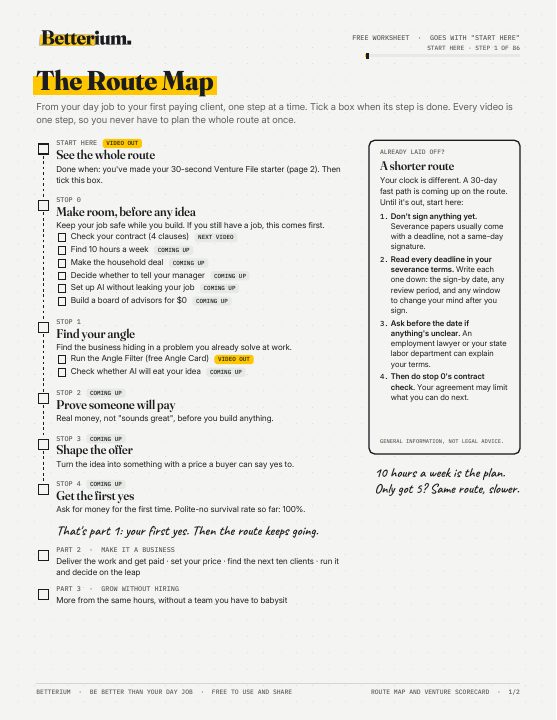
Get the Route Map and Venture Scorecard
The whole route on one page, a starter Venture File you can use from the first lesson, and a scorecard that counts asks and yeses, not documents
In short
- Five stops sit between your day job and your first paying client.
- Every lesson covers one step, with a "done when" line, an honest number of hours, a free worksheet and one AI step.
- Progress goes on the Venture Scorecard: five boxes you tick, and no revenue number.
Who is this route for?
You're good at your job, but lately that doesn't feel like much of a guarantee. You want something of your own, built on the side while the paycheck keeps coming in. Not the LinkedIn version, where someone quits on Monday and posts a sunset from their new "office" by Friday.
This route runs from your day job to your first paying client. Part two turns that client into a real business. Part three grows it without hiring.
What are the five stops?
Stop 0: Make room. Keep your job safe while you build: your contract, ten hours a week, a deal with the people you live with, whether to tell your manager, safe AI, and free advisors.
Stop 1: Find your angle. Dig out the business hiding inside a problem you already solve at work. That's Stop Looking for a Business Idea (coming soon).
Stop 2: Prove someone will pay. Check that real buyers will hand over money before you build.
Stop 3: Shape the offer. Put a price on it that a buyer can say yes to.
Stop 4: Get the first yes. Ask for money for the first time. So far, nobody has died from a polite no.
If you have a job, stop 0 comes first. Before you tell anyone your idea, make sure your employer can't claim it.
How do you measure progress without income?
The gurus will tell you to quit by spring and hit six figures by summer. It's a lovely story, and it tastes like a protein bar. Mostly cardboard, with a hint of regret.
The Venture Scorecard has five boxes you tick as you go, and no revenue number, on purpose. Nobody can honestly promise you income, and that includes us. You get the steps instead, and a clear way to tell whether they're working.
Why keep your AI work in one place?
Most people use AI like a vending machine, with a new chat for every question. Three months later, the plan is scattered across forty conversations.
Here, every AI step builds inside one project, your Venture File. The starter takes thirty seconds:
- Open ChatGPT, Claude or Gemini, create one project, and call it Venture File.
- In settings, turn off the option that lets it train on your chats.
- Nothing from work ever goes in. No documents, no emails, not even a customer's name.
What if a step doesn't work?
Some won't, and that's the route doing its job. Finding out early is cheaper than finding out six months later. Every worksheet ends with a "Stuck on this step?" box: why it usually happens, one thing to do in the next thirty minutes, and where to go next. A clean no still counts as progress.
Every idea also gets one extra test: is AI about to do this job for free? So the route leans on what's hardest to hand over: owning the outcome, making the judgment call, and taking the phone call when it breaks.
Try it this week
See the whole route, make the thirty-second Venture File starter and tick your first milestone. It takes about an hour. The free Route Map and Venture Scorecard worksheet walks you through it.
Put this lesson to work with the Route Map and Venture Scorecard
Questions people ask
Do I need a business idea before I start?
No. Stop 0 comes first, and stop 1 finds one inside a problem you already solve at work.
What if I only have five hours a week?
That's fine. The route plans around ten hours a week. With five, you move slower, never backwards. If a step doesn't fit, we cut the step, not your sleep.
What if I've already been laid off?
Your clock is different, so there's a 30-day fast path on the route for you. Step one, before you sign anything: read every deadline in your severance terms.